CELPIP Speaking Task 3: Describing a Scene
In Task 3 you describe a picture to someone who cannot see it. You have 30 seconds to prepare and 60 seconds to speak. Start with the big picture, then describe some details, including the people.
Practice Describing a Scene NowThe official format of Speaking Task 3: Describing a Scene
CELPIP's official strategies for Task 3
From CELPIP's Speaking Pro: Target 9+ Study Pack (2026).
- Start with a general statement.
- Then focus on some details. You don't need to describe everything.
- Build a picture.
- Use descriptive words and phrases.
- Describe the people's appearance, actions, and feelings.
A 4-step structure for Task 3
Start with the place and time, then the people in front, then the people behind, and finish with the mood. For each person, say how they look, what they are doing, and how they feel.
CELPIP Speaking Task 3 sample answer (60 seconds)
Describe some things that are happening in the picture below as well as you can. The person with whom you are speaking cannot see the picture.

In this picture, I can see an outdoor skating rink in the middle of the city on a winter evening. There are snowy pine trees all around it, tall buildings behind them, and strings of little lights hanging over the ice.
In the foreground, a father in a bright red parka is holding his little daughter's hand. She's wearing a purple snowsuit and a pink hat, and she's wobbling on her skates. She looks pretty nervous, but her dad looks calm and happy. Right beside them, a teenage boy in a green hoodie has just fallen on the ice, and he's lying there laughing at himself.
In the background, an older couple in matching striped scarves is skating slowly, hand in hand, and they look completely relaxed. On the right, a woman at a little wooden stand is pouring hot chocolate for a line of kids, and she seems to be enjoying herself.
Overall, it looks like a cold but cheerful evening, where everyone, from the nervous little girl to the older couple, is having a good time together.
A general statement first, then the people's appearance, actions and feelings, which is CELPIP's strategy 5. This answer was spoken within the 60-second limit.
A free CELPIP Speaking Task 3: Describing a Scene practice question
Picture Description ST B001
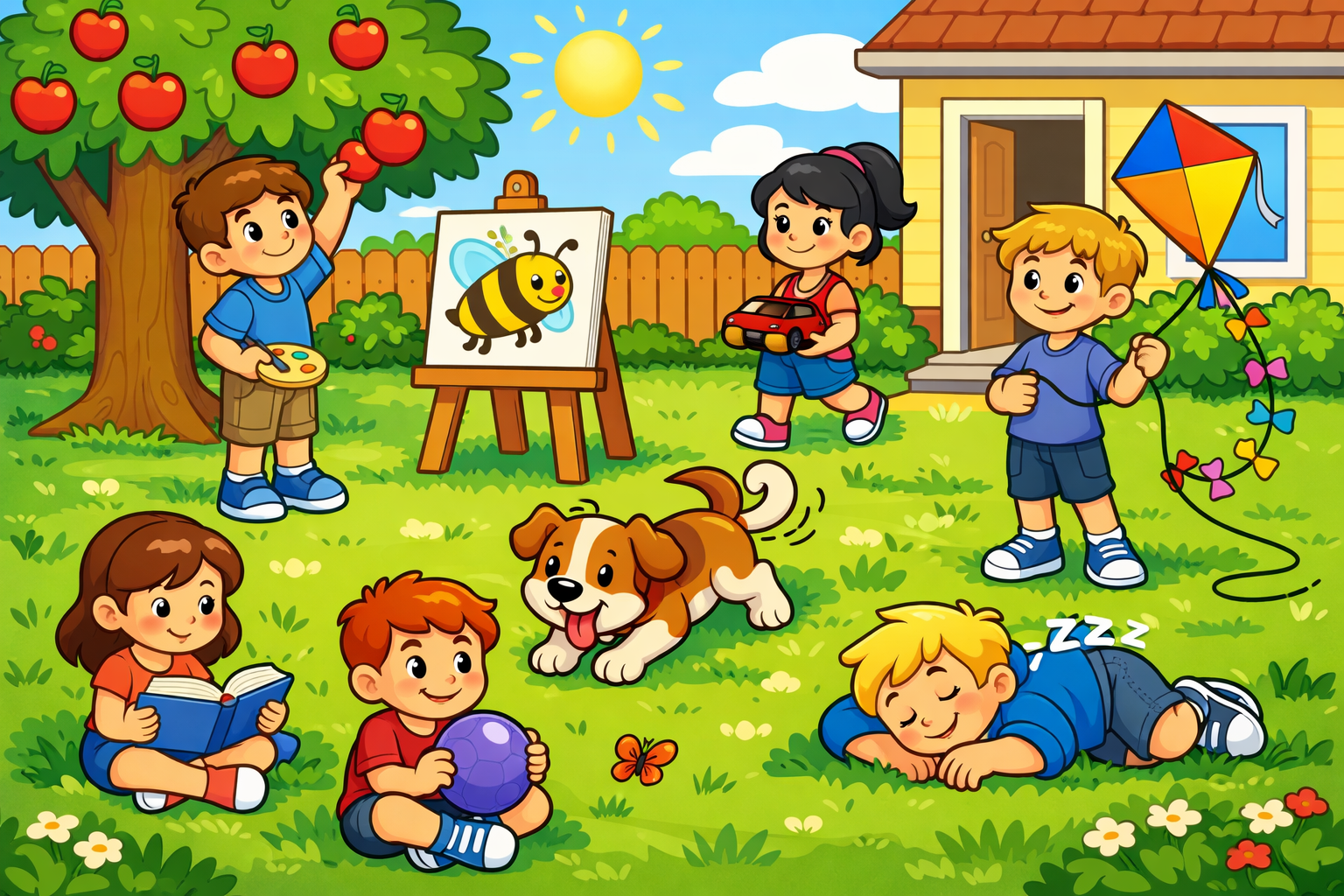
Describe some things that are happening in the picture below as well as you can. The person with whom you are speaking cannot see the picture.
Show the sample answer (CLB 9-10)
This vibrant illustration depicts a delightful scene of childhood recreation taking place in a well-maintained backyard environment. The composition features six children engaged in diverse leisure activities under pleasant weather conditions. To the left, an artistic young boy is simultaneously picking a red apple from a flourishing fruit tree while painting a cheerful bee illustration on a wooden easel, demonstrating multitasking creativity. The central area showcases a girl with dark hair enjoying some form of play activity, accompanied by an energetic brown and white dog that appears to be in mid-motion with its tongue playfully extended. On the right side, a blonde child is skillfully maneuvering a geometrically-shaped kite with blue, red, yellow, and orange panels against the clear sky. The foreground presents two additional children in restful positions: a brunette girl absorbed in reading a book and a red-haired boy clutching a purple ball. The domestic setting is completed by a charming house featuring terracotta roof tiles and multiple windows, with the entire scene bathed in warm sunlight punctuated by fluffy white clouds.
Scenes to practice CELPIP Speaking Task 3 with
Find a picture of each scene, set a timer for 60 seconds, and describe it to someone who cannot see it: the big picture first, then the people.
- A busy farmers market on a Saturday morning, with shoppers, vendors and a street musician.
- A family picnic beside a lake on a sunny afternoon.
- A crowded airport check-in area during a holiday weekend.
- A public library on a rainy afternoon, with students, children and a librarian.
- A city bus stop on a snowy morning, with people waiting in winter clothes.
- A backyard birthday party for a child, with balloons, a cake and guests.
Common mistakes on Task 3: Describing a Scene
- Trying to describe everything. CELPIP says you don't need to, so choose the details that build a clear picture.
- Starting with a small detail instead of a general statement about the place and the time.
- Naming objects but not the people's appearance, actions and feelings.
- Using vague words like "thing" and "nice" instead of specific, descriptive ones.
Ready to practice?
Practice Describing a Scene questions with instant scoring and detailed explanations.
Start PracticingTask 3: Describing a Scene FAQ
How long do I have for CELPIP Speaking Task 3?+
30 seconds to prepare and 60 seconds to speak.
What should I describe first in Task 3?+
Start with a general statement about the scene, such as where it is and when, then move to the details.
Do I have to describe everything in the picture?+
No. CELPIP's study pack says you don't need to describe everything. Focus on details that help the listener build a picture, especially the people.
Is Task 4 related to Task 3?+
Yes. Task 4 uses the same picture as Task 3 and asks what you think will happen next.
What CELPIP Speaking score do I need for Express Entry?+
Express Entry's Federal Skilled Worker program needs at least CLB 7 in speaking and in each other skill, and the most first-language points start at CLB 10. Canadian citizenship needs CLB 4 in speaking and listening.