CELPIP Speaking Task 4: Making Predictions
In Task 4 you look at the same picture as Task 3 and say what you think will happen next. You have 30 seconds to prepare and 60 seconds to speak. For each person, say what they might do and how they might feel.
Practice Making Predictions NowThe official format of Speaking Task 4: Making Predictions
CELPIP's official strategies for Task 4
From CELPIP's Speaking Pro: Target 9+ Study Pack (2026).
- Use your imagination, but be realistic. Your predictions should be related to what you see the people doing.
- Ask yourself: What actions might the people do next, and what feelings might they experience as a result?
- Consider the surrounding people and objects in the picture to help you think of ideas.
A 4-step structure for Task 4
Describe the scene now, point out the clues, then predict. For each person: who it is, what they will do, and how they will feel. CELPIP's own Level 9 sample names each person and what they will do, but never says how anyone will feel.
CELPIP Speaking Task 4 sample answer (60 seconds)
In this picture, what do you think will happen next?
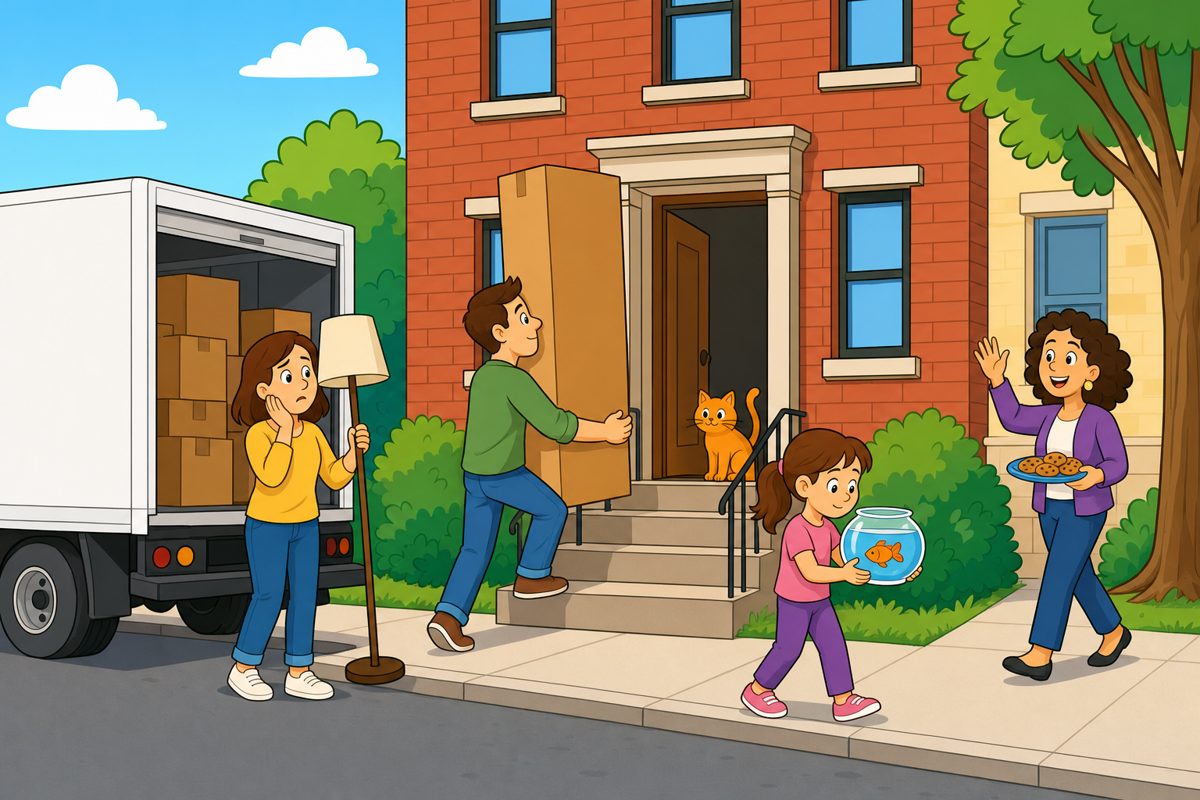
In this picture, I can see a family moving into a new apartment building on a sunny afternoon. Their moving truck is parked by the sidewalk, and it's still full of boxes, so it looks like they've only just started.
But if I look closely, a few things are about to happen. The dad is carrying a box that's taller than the front door, the cat is sitting in the open doorway, and their little girl is bringing a goldfish bowl. A neighbor is also walking over with a plate of cookies.
So I think the father is going to hit the top of the door frame, and he'll have to tip the box sideways. He'll probably feel a little embarrassed, because his wife is watching. Then the cat will spot the goldfish, so the girl will hold the bowl up high, and she'll feel nervous until she gets inside.
As a result, moving in will take a little longer. But when the neighbor gets there, the mother will put down the lamp to say hello, and she'll feel really welcome. I think moving day will end on a happy note.
Three people, each with an action and a feeling, every prediction based on something in the picture, and a closing line. This answer was spoken within the 60-second limit.
A free CELPIP Speaking Task 4: Making Predictions practice question
Predict Next Event B001
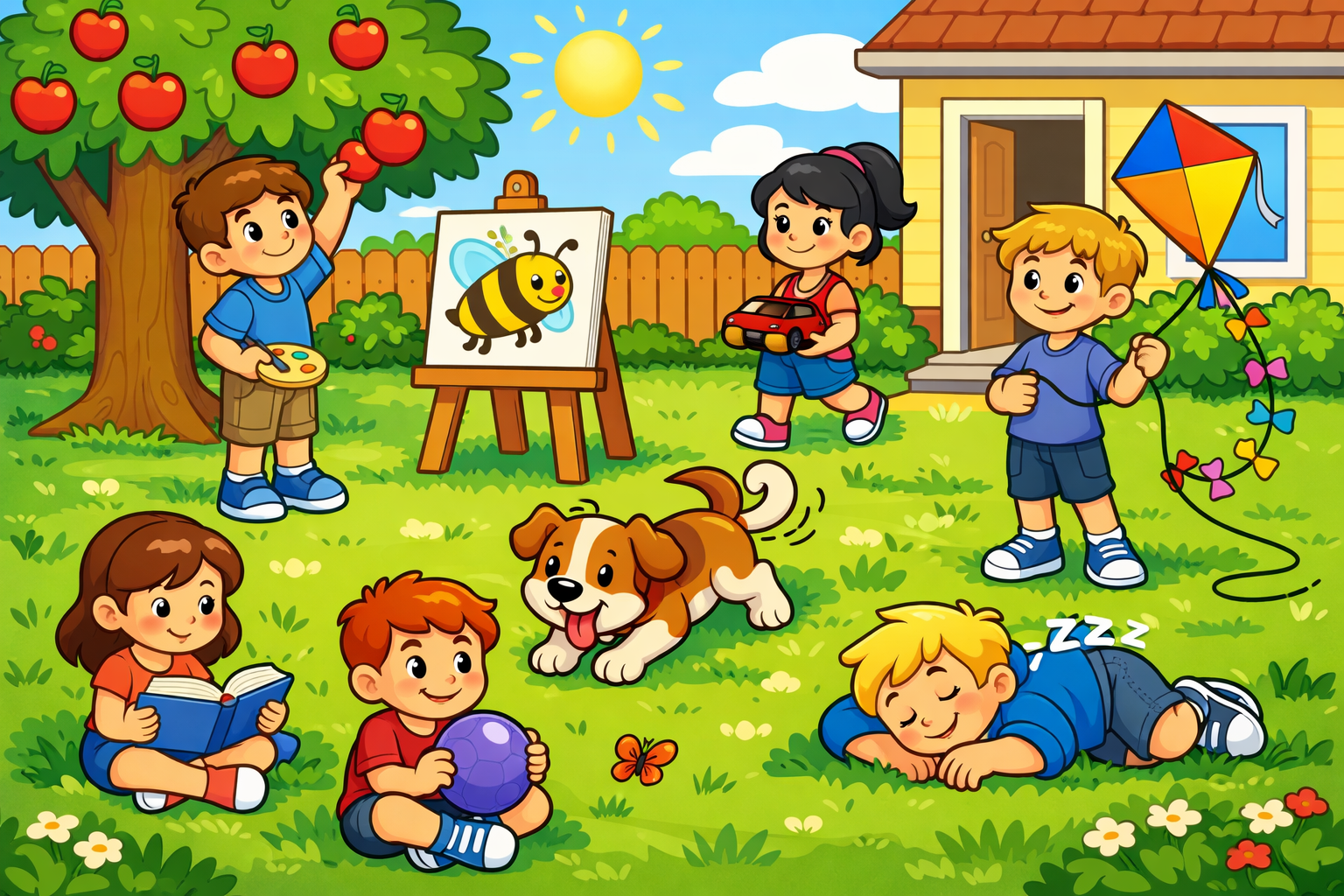
In this picture, what do you think will most probably happen next?
Show the sample answer (CLB 9-10)
Based on the idyllic scene before me, I anticipate several developments will unfold naturally. The young artist will undoubtedly continue refining his charming bee illustration, as evidenced by his focused posture and readily available painting supplies, likely adding intricate details or vibrant background elements. The boy with the colorful kite will maintain his aerial adventure, taking advantage of what appears to be optimal wind conditions and the expansive open space. The absorbed reader will probably complete her current chapter before potentially transitioning to join the more active pursuits around her. Meanwhile, the energetic dog will continue its playful interactions with the children, possibly initiating games of fetch or chase. The child holding the ball will likely organize a group activity, drawing the others into collaborative play. Given the perfect weather conditions, abundant space, and the children's evident enthusiasm, this delightful outdoor gathering will probably extend well into the afternoon, with activities naturally flowing from individual pursuits to more social interactions.
Scenes to practice CELPIP Speaking Task 4 with
Each scene has a clue about what will happen next. Say who it involves, what they will do, and how they will feel, in 60 seconds.
- A kitchen where a pot is about to boil over while the cook is talking on the phone.
- A soccer game in a park where a ball is flying toward a family's picnic blanket.
- A grocery store where a child is reaching for a box at the bottom of a tall stack.
- A beach where dark clouds are coming in and people are still swimming.
- A birthday party where the host is carrying a cake and a dog is watching from under the table.
- An office where someone is about to sit on a chair that has a cup of coffee on it.
Common mistakes on Task 4: Making Predictions
- Describing the picture again instead of predicting what will happen next.
- Making predictions that have nothing to do with what the people are doing in the picture.
- Giving actions only. CELPIP asks what the people will do AND how they will feel as a result.
- Making one general prediction about everyone ("they will all have fun") instead of several about specific people.
Ready to practice?
Practice Making Predictions questions with instant scoring and detailed explanations.
Start PracticingTask 4: Making Predictions FAQ
How long do I have for CELPIP Speaking Task 4?+
30 seconds to prepare and 60 seconds to speak.
Is the Task 4 picture the same as Task 3?+
Yes. CELPIP describes Task 4 as looking at the same illustration from Task 3 and describing what you think will happen next.
How many predictions should I make?+
Several. CELPIP's Level 9 sample "provides several predictions" and makes clear which person each one is about.
Should my predictions be creative?+
Use your imagination, but be realistic. Base each prediction on something you can see in the picture.
What CELPIP Speaking score do I need for Express Entry?+
Express Entry's Federal Skilled Worker program needs at least CLB 7 in speaking and in each other skill, and the most first-language points start at CLB 10. Canadian citizenship needs CLB 4 in speaking and listening.